Kafka vs RabbitMQ: choosing the right message broker
When we talk about distributed systems, high concurrency, applications that have to scale to a high volume of requests per second and asynchronous operations, message queues come into play. From there, there are several technologies with their pros and cons, and the main ones are Kafka and RabbitMQ. In this post we’ll explore both, along with some use cases that will help us decide when it’s “better” to use one or the other.
Understanding Kafka: a distributed streaming system
Apache Kafka is an open source distributed event streaming platform known for its high throughput, fault tolerance and real-time data processing. Kafka follows a publish-subscribe model where producers write messages to topics and consumers subscribe to those topics to receive them. Kafka stores messages in a distributed commit log, which gives it high scalability and fault tolerance. This enables high throughput and message replay, making it ideal for real-time data processing and event sourcing.
Kafka’s architecture has three main components: producers, brokers and consumers. Producers publish messages to Kafka topics, and brokers store and replicate the data across the Kafka cluster. Consumers read data from one or more topics, which allows parallel processing and scalability.
RabbitMQ: a flexible, reliable message broker
RabbitMQ is a flexible, open source message broker that implements the AMQP protocol. It follows a traditional message queue model, letting applications communicate asynchronously by sending and receiving messages, with messages delivered in order to specific consumers. This guarantees reliable message ordering and flexible message routing, making it a good fit for task processing and microservice communication.
RabbitMQ’s architecture centres on a central message broker that acts as an intermediary between producers and consumers. For replication and message retention, producers send messages to exchanges, and those exchanges route the messages to queues based on predefined rules. Consumers then pick up the messages from the queues and process them.
Fundamental differences: architecture and consumption model
On one side there’s the Broker, the intermediary: the infrastructure and how each of these technologies works inside. On the other side there’s the Consumer, which is how we consume from that Broker, and that changes a lot.
RabbitMQ
-
In RabbitMQ, the
Brokeris considered aSmart Brokerbecause it does a lot of work, such as routing messages, persisting them and delivering them to the right consumers. -
The
BrokerusesExchangesto receive messages from producers. Each message carries aRouting Key, which theExchangeexamines to decide whichQueuesto send the message to, based on theBindingsthat have been set up. -
A
Bindingis a relationship between anExchangeand aQueue, and it defines which messages should be routed to a specificQueue. The relationship is established with aBinding Key. -
RabbitMQ supports different types of
Exchanges, such asDirect,Fanout,TopicandHeaders, each with its own algorithm for comparing the message’sRouting Keywith theBinding Keysto decide the routing. -
A powerful feature of RabbitMQ is message
Multiplexing, where a single message can be delivered to severalQueuesif theirBinding Keysmatch the message’sRouting Key. This lets severalConsumershandle the same message for different purposes. -
In contrast to the
Smart Broker,Consumersin RabbitMQ are consideredDumb Consumers, because their only responsibility is to consume messages from theQueuesthey’re subscribed to. By default, RabbitMQ delivers messages toConsumersevenly using aRound-Robinalgorithm. -
This
Smart BrokerandDumb Consumerdesign gives a highly flexible and scalable messaging system, where components can be changed or replaced independently as long as they follow the agreed messaging conventions.

This diagram shows an example of the message flow in RabbitMQ. The Producer sends several events (sales_event, inventory_update, price_change) to the Exchange. The Exchange routes these messages to the right Queues based on the Routing Keys and Bindings.
The messages are then consumed by different Consumers to carry out various tasks, such as updating the sales database (CRM), processing inventory updates (Inventory), updating prices on the website (Website) and generating sales reports (Analytics).
This example shows how RabbitMQ enables decoupled communication between the different components of a system, allowing asynchronous, scalable processing of events and tasks.
Kafka
-
In Kafka, messages don’t go to a central
Broker; they’re stored inTopicsin a distributedLog. Kafka follows aPublish-Subscribemodel, whereProducerspublish messages toTopicsandConsumerssubscribe to thoseTopicsto receive them. -
A
Topicin Kafka is a named category or feed that records are published to.Topicsin Kafka are always multi-producer and multi-consumer: aTopiccan have zero, one or manyProducerswriting to it, and zero, one or manyConsumersreading from it. -
For each
Topic, the Kafka cluster keeps a partitionedLog. Each partition is an ordered, immutable sequence of records that is continually appended to a structured commit log. Each record in the partition gets a sequential ID number called theOffset, which uniquely identifies it within the partition. -
Kafka is a distributed system, so a
Topicusually has several partitions spread across several servers in the Kafka cluster. This allows it to scale beyond the capacity of a single server. -
Consumerslabel themselves with aConsumer Groupname, and each record published to aTopicis delivered to one consumer instance within each subscribedConsumer Group.Consumer Instancescan be in separate processes or on separate machines. -
If all the
Consumerinstances share the sameConsumer Group, records are effectively load-balanced across them. If all theConsumerinstances have differentConsumer Groups, each record is broadcast to everyConsumerprocess.
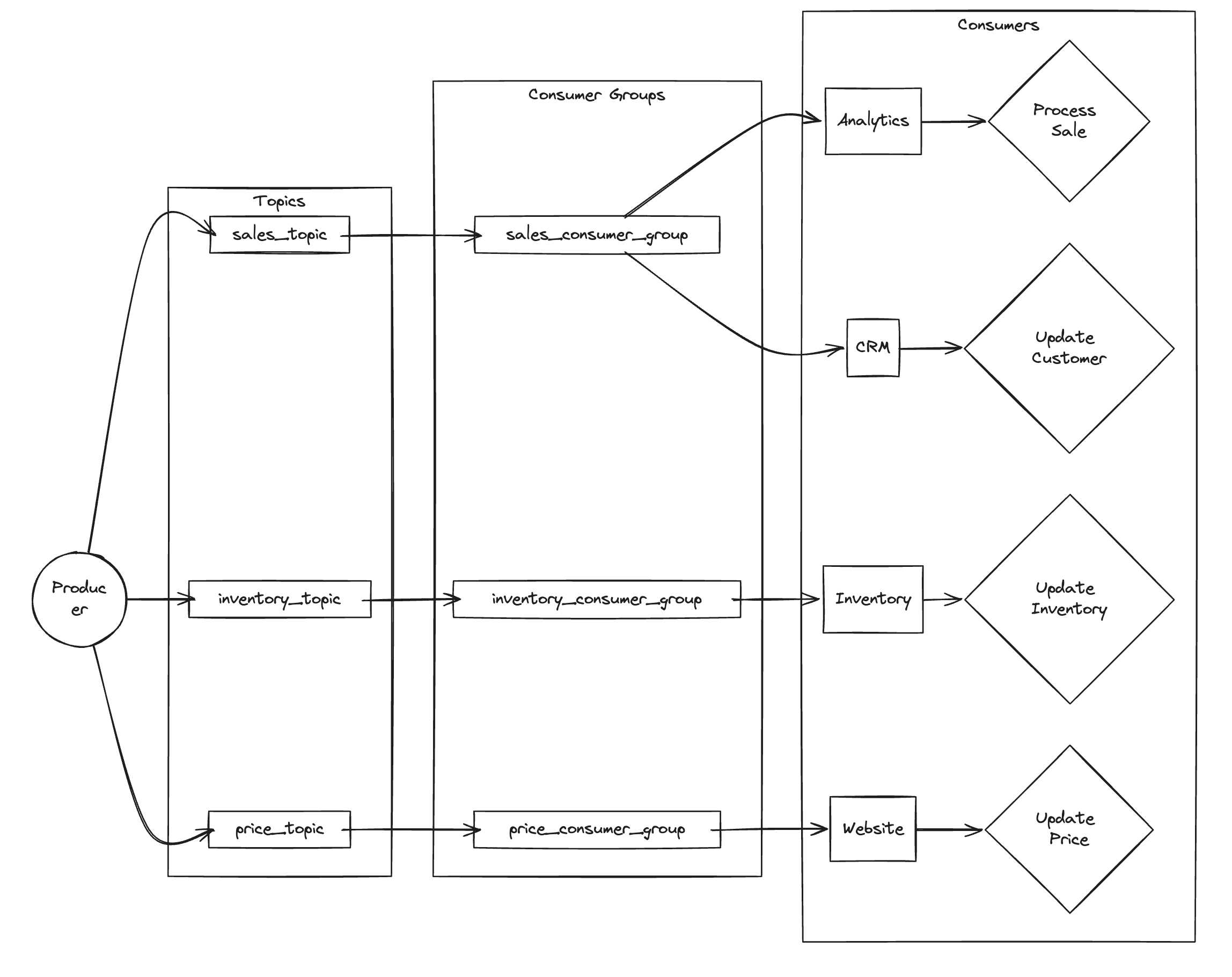
-
The
Producerpublishes messages to threeTopics:sales_topic,inventory_topicandprice_topic. -
Each
Topichas its ownConsumer Group:sales_consumer_group,inventory_consumer_groupandprice_consumer_group. TheConsumer Groupssubscribe to theTopicsto consume messages. -
Inside each
Consumer Groupthere are individualConsumersthat perform specific actions:Analyticsprocesses sales.CRMupdates customer information.Inventoryupdates theinventory.Websiteupdates prices.
-
TopicsinKafkaarepartitionedandreplicatedforscalabilityandfault tolerance. Eachpartitionis an ordered, immutablelogof messages. -
Consumerskeep their ownoffset(position) in eachpartitionthey consume, so each can consume independently at its own pace.
Performance and scalability: Kafka vs RabbitMQ
In terms of performance, Kafka and RabbitMQ offer similar functionality but have different strengths.
Kafka
It excels at real-time, high-throughput data streaming, with excellent scalability and low latency. It can handle millions of messages per second, which suits use cases that need fast, continuous data processing. Its architecture scales horizontally by spreading the workload across several brokers, handling large volumes of data efficiently. It also gives strong durability guarantees by persisting messages to disk, ensuring fault tolerance and data durability.
RabbitMQ
It offers reliable message delivery through features such as acknowledgements and message persistence. It can handle thousands of messages per second, which suits use cases with moderate throughput requirements. Its centralized architecture can add some performance overhead, but it offers robustness and message integrity. It scales vertically, but its horizontal scaling is limited compared with Kafka.
Ideal use cases for Kafka and RabbitMQ
Kafka
Ideal for a wide variety of use cases:
- Real-time analytics and
streamingapplications Event sourcing, ingestion andlog aggregation, especially withbig data.Data pipelinesand microservice communication with high-volume message processing- Applications that need high scalability and fault tolerance
RabbitMQ
A good fit for:
Task processing, service integration,workflow orchestrationand workflow management, including metrics and notifications.- Asynchronous communication between microservices
- Enterprise messaging systems with reliable message delivery, including message priority and specific complex routing needs.
RabbitMQ’s flexibility in supporting messaging patterns such as point-to-point, publish-subscribe and request-response makes it useful in many application scenarios.
A guide to making the right choice
In the end, the best choice depends on your specific needs:
- Do you prioritize high throughput and real-time data processing? Use Kafka.
- Do you need reliable message delivery and flexible routing for moderate workloads? Use RabbitMQ.
- Are you considering
message replayandlog aggregation? Kafka is the strong candidate. - Are you looking for seamless scalability for high-volume microservice communication? Kafka supports it.
Remember: neither is inherently “better”. Analyzing your specific requirements and weighing factors such as redundancy, scalability, high throughput, high availability, a large-scale API and security is vital to making an informed decision.
Other things to consider
- Complexity: Kafka’s distributed architecture and
append-onlylog may need more operational experience than RabbitMQ’s simpler queue-based approach. - Community and support: both platforms have large communities and active development.
- Integration: evaluate the integrations available with your existing infrastructure and tools.
Choosing the right path for your event-driven architecture
With a clear understanding of the architectural differences, the performance benchmarks and the ideal use cases, you can choose between Kafka and RabbitMQ with confidence. So dig into your project’s specific needs and set off towards a robust, efficient event-driven architecture.