Getting to know Keycloak: reviewing, refactoring and updating the implementation.
Hello again! If you remember, in my previous post we dived straight into Keycloak with Spring Boot. Yes, I know, the implementation was a bit rushed and, I admit, I skipped the unit tests. 😅 But who hasn’t done that at some point, right?
So in this post we’ll review and refactor the code to try to follow good programming practices, and update the implementation of our little Keycloak app.
Reviewing the code.
First, let’s look at what our project looks like right now:
.
├── HELP.md
├── mvnw
├── mvnw.cmd
├── pom.xml
└── src
    ├── main
    │   ├── java
    │   │   └── me
    │   │       └── romeralvarez
    │   │           └── springexamplekeycloak
    │   │               ├── SpringExampleKeycloakApplication.java
    │   │               ├── clients
    │   │               │   └── KeycloakClient.java
    │   │               ├── commons
    │   │               │   └── Constants.java
    │   │               ├── configuration
    │   │               │   ├── JwtAuthenticationConverter.java
    │   │               │   └── SecurityConfiguration.java
    │   │               ├── controllers
    │   │               │   ├── KeycloakAuthController.java
    │   │               │   ├── KeycloakController.java
    │   │               │   └── requests
    │   │               │       ├── UserLoginRequest.java
    │   │               │       └── UserRequest.java
    │   │               └── services
    │   │                   ├── KeycloakAuthServiceImpl.java
    │   │                   ├── KeycloakServiceImpl.java
    │   │                   └── interfaces
    │   │                       ├── KeycloakAuthService.java
    │   │                       └── KeycloakService.java
    │   └── resources
    │       ├── application.yaml
    │       ├── banner.txt
    │       ├── static
    │       └── templates
    └── test
        └── java
            └── me
                └── romeralvarez
                    └── springexamplekeycloak
└── SpringExampleKeycloakApplicationTests.java- To start with, a very simple change: we have directories we don’t need, such as
staticandtemplatesinsideresources, since we won’t use templates or anything like that. So we’ll delete them. - Another simple change: we’ll turn the
me.romeralvarez.springexamplekeycloak.controllers.requestspackage into a DTO package, so we’ll rename it tome.romeralvarez.springexamplekeycloak.dtos.
Constants.java
This class holds the application’s constants. However, it has credentials, URLs and other data that shouldn’t live in the code, so we’ll move them to a configuration file.
In our case we’ll move the constants to an application.yaml file in the resources directory, but ideally you’d use a secrets store such as Vault or AWS Secrets Manager.
The decision we’ll make is to delete this class and move the constants to an application.yaml file in the resources directory.
keycloak:
  url: http://localhost:8080/
  realm-name: spring-boot-realm-dev
  realm-master: master
  admin-cli: admin-cli
  user-console: admin
  user-password: admin
  client-secret: DdWW14rqntQlMvr2AtgCZ1GD7kGSBWsw
  client-id: spring-client-api-rest
KeycloakClient.java
Let’s review the code of the KeycloakClient.java class.
The KeycloakClient class acts as a client that makes it easier to talk to the Keycloak server:
-
Initializing the Keycloak instance:
- The class has a static Keycloak instance (keycloakInstance) that is initialized with the KeycloakBuilder. This instance is configured with details such as the Keycloak server URL (KEYCLOAK_URL), the realm (REALM_MASTER), the client ID (ADMIN_CLI), the username (USER_CONSOLE), the password (USER_PASSWORD), the client secret (CLIENT_SECRET) and extra details for the REST client (resteasyClient).
-
Getting the realm resource (RealmResource): the getRealmResource() method returns a realm resource that provides the functionality to manage that particular realm in Keycloak.
-
Getting the users resource (UsersResource): the
getUsersResource()method returns a resource that provides the functionality to manage users within a specific realm. -
Creating a KeycloakBuilder instance:
createKeycloakBuilder(String username, String password)creates and returns a new KeycloakBuilder instance configured with the given username and password. -
Getting a user’s access token:
getAccessTokenForUser(String username, String password)creates a new Keycloak instance withcreateKeycloakBuilder, then requests and returns an access token for the given user.
public class KeycloakClient {

  private static final Keycloak keycloakInstance = KeycloakBuilder.builder()
      .serverUrl(KEYCLOAK_URL)
      .realm(REALM_MASTER)
      .clientId(ADMIN_CLI)
      .username(USER_CONSOLE)
      .password(USER_PASSWORD)
      .clientSecret(CLIENT_SECRET)
      .resteasyClient(new ResteasyClientBuilderImpl()
          .connectionPoolSize(10).build())
      .build();

  public static RealmResource getRealmResource() {
    return keycloakInstance.realm(REALM_NAME);
  }

  public static UsersResource getUsersResource() {
    RealmResource realmResource = getRealmResource();
    return realmResource.users();
  }

  public static KeycloakBuilder createKeycloakBuilder(String username, String password) {
    return KeycloakBuilder.builder()
        .realm(REALM_NAME)
        .serverUrl(KEYCLOAK_URL)
        .clientId(CLIENT_ID)
        .clientSecret(CLIENT_SECRET)
        .username(username)
        .password(password);
  }

  public static AccessTokenResponse getAccessTokenForUser(String username, String password) {
    return createKeycloakBuilder(username, password)
        .build()
        .tokenManager()
        .getAccessToken();
  }

}- The first change here is to update the constructor and the methods that used the constants, because of the change we just made.
@Component
public class KeycloakClient {

   @Value("${keycloak.url}")
  private String keycloakUrl;

  @Value("${keycloak.realm-name}")
  private String realmName;

  @Value("${keycloak.realm-master}")
  private String realmMaster;

  @Value("${keycloak.admin-cli}")
  private String adminCli;

  @Value("${keycloak.user-console}")
  private String userConsole;

  @Value("${keycloak.user-password}")
  private String userPassword;

  @Value("${keycloak.client-secret}")
  private String clientSecret;

  @Value("${keycloak.client-id}")
  private String clientId;

  private Keycloak keycloakInstance;

  @PostConstruct
  public void init() {
    this.keycloakInstance = createKeycloakInstance();
  }

  protected Keycloak createKeycloakInstance() {
    return KeycloakBuilder.builder()
        .serverUrl(keycloakUrl)
        .realm(realmMaster)
        .clientId(adminCli)
        .username(userConsole)
        .password(userPassword)
        .clientSecret(clientSecret)
        .resteasyClient(new ResteasyClientBuilderImpl().connectionPoolSize(10).build())
        .build();
  }

  public RealmResource getRealmResource() {
    return keycloakInstance.realm(realmName);
  }

  public UsersResource getUsersResource() {
    RealmResource realmResource = getRealmResource();
    return realmResource.users();
  }

  public KeycloakBuilder createKeycloakBuilder(String username, String password) {
    return KeycloakBuilder.builder()
        .realm(realmName)
        .serverUrl(keycloakUrl)
        .clientId(clientId)
        .clientSecret(clientSecret)
        .username(username)
        .password(password);
  }

  public AccessTokenResponse getAccessTokenForUser(String username, String password) {
    return createKeycloakBuilder(username, password)
        .build()
        .tokenManager()
        .getAccessToken();
  }

}- First, we’ve used the
@Valueannotation to inject the properties from our configuration file. - The other change is the
@PostConstructannotation, which marks the method to run once dependency injection is done. In other words, once Spring has injected all the values (from application.yml) into our fields, it calls theinit()method. In that method we initialize our Keycloak instance with the injected configuration values. - The first step before refactoring is to have a good set of tests (which we don’t have), so the step before that is to make the code testable. We’ve made these changes:
- We’ve moved the logic that creates the
Keycloakinstance into a new protected method,createKeycloakInstance(). The reason is to decouple creating theKeycloakinstance from initializing the bean. That gives us several things:- Separation of concerns: the
init()method now only initializes the bean, while the logic that creates theKeycloakinstance lives in a separate method. - Better testability: with the creation in its own method, we can override or mock that specific method in a test. That’s especially useful when we want to avoid real connections to external services (such as Keycloak) in unit tests.
- Separation of concerns: the
- We’ve removed the static methods and turned them into instance methods. By not depending directly on static methods to create instances, and being able to inject or override those instances, the class becomes less coupled and more modular.
- We’ve moved the logic that creates the
KeycloakServiceImpl.java
- Now that we’ve refactored the
KeycloakClientclass, we can refactorKeycloakServiceImplso it uses the newKeycloakClientclass instead of theKeycloakinstance directly.
Let’s look at what the class looked like before:
@Service
@Slf4j
public class KeycloakServiceImpl implements KeycloakService {

  @Override
  public List<UserRepresentation> findAllUsers() {
    log.info("Finding all users");
    log.info("Realm: {}", KeycloakClient.getRealmResource().toRepresentation().getRealm());
    return KeycloakClient.getRealmResource().users().list();
  }

  @Override
  public List<UserRepresentation> searchByUsername(String username) {
    return KeycloakClient.getRealmResource().users().searchByUsername(username, true);
  }

  @Override
  public String createUser(@NonNull UserRequest userRequest) {
    log.info("Creating user");
    int status = 0;

    log.info("Realm: {}", KeycloakClient.getRealmResource().toRepresentation().getRealm());
    UsersResource usersResource = KeycloakClient.getUsersResource();
    UserRepresentation userRepresentation = new UserRepresentation();

    log.info("Setting user attributes");
    userRepresentation.setFirstName(userRequest.firstName());
    userRepresentation.setLastName(userRequest.lastName());
    userRepresentation.setEmail(userRequest.email());
    userRepresentation.setUsername(userRequest.username());
    userRepresentation.setEnabled(true);
    userRepresentation.setEmailVerified(true);

    Response response = usersResource.create(userRepresentation);
    status = response.getStatus();

    if (status == 201) {
      log.info("User created");
      String path = response.getLocation().getPath();
      String userId = path.substring(path.lastIndexOf('/') + 1);
      log.info("User id: {}", userId);

      log.info("Setting user password");
      CredentialRepresentation credentialRepresentation = new CredentialRepresentation();
      credentialRepresentation.setTemporary(false);
      credentialRepresentation.setType(OAuth2Constants.PASSWORD);
      credentialRepresentation.setValue(userRequest.password());

      log.info("Resetting user password");
      usersResource.get(userId).resetPassword(credentialRepresentation);

      log.info("Assigning user roles");
      RealmResource realmResource = KeycloakClient.getRealmResource();
      List<RoleRepresentation> roles = null;

      if(userRequest.roles() == null || userRequest.roles().isEmpty()){
        roles = List.of(realmResource.roles().get("user").toRepresentation());
      } else {
        roles = realmResource
            .roles()
            .list()
            .stream()
            .filter(role -> userRequest.roles()
                .stream()
                .anyMatch(roleName -> roleName.equalsIgnoreCase(role.getName())))
            .toList();
      }
      realmResource
          .users()
          .get(userId)
          .roles()
          .realmLevel()
          .add(roles);

      return "User created";
    } else if (status == 409) {
      log.error("User already exists");
      return "User already exists";
    } else {
      log.error("Error creating user");
      return "Error creating user";
    }

  }

  @Override
  public void deleteUser(String userId) {
    log.info("Deleting user");
    log.info("Realm: {}", KeycloakClient.getRealmResource().toRepresentation().getRealm());
    KeycloakClient.getUsersResource().get(userId).remove();
  }

  @Override
  public void updateUser(String userId, UserRequest userRepresentation) {
    log.info("Updating user");
    log.info("Realm: {}", KeycloakClient.getRealmResource().toRepresentation().getRealm());
    CredentialRepresentation credentialRepresentation = new CredentialRepresentation();
    credentialRepresentation.setTemporary(false);
    credentialRepresentation.setType(OAuth2Constants.PASSWORD);
    credentialRepresentation.setValue(userRepresentation.password());

    UserRepresentation user = new UserRepresentation();
    user.setFirstName(userRepresentation.firstName());
    user.setLastName(userRepresentation.lastName());
    user.setEmail(userRepresentation.email());
    user.setUsername(userRepresentation.username());
    user.setEnabled(true);
    user.setEmailVerified(true);
    user.setCredentials(Collections.singletonList(credentialRepresentation));

    UserResource userResource = KeycloakClient.getUsersResource().get(userId);
    userResource.update(user);
  }
}
At a glance you can see plenty of repeated code, very long methods, magic numbers, code smells and so on. Let’s go through what’s going on:
- Long methods: long methods are a problem because they’re hard to read and understand. They also usually mean the class is doing too many things. Here, the
createUser()andupdateUser()methods are very long and do too much. For example,createUser()does all of this:- Creates a user
- Sets their password
- Assigns their roles
- Duplicated code: the logic to get the realm is repeated in several methods (
findAllUsers,createUser,deleteUser,updateUser). - Lack of abstraction: the logic to build a user representation and credentials is repeated in
createUserandupdateUser. It could be pulled out into separate methods or even a helper class. - It uses an interface that doesn’t really add anything: for this project there will only ever be one implementation, Keycloak. It’s a very small project and we won’t switch authentication providers either.
Now that we’ve looked at some of the problems, let’s refactor the class:
- First we’ll drop the interface implementation and rename the class to
KeycloakService. - We’ll define constants for the HTTP status codes.
- We’ll make
KeycloakClienta field of the class.
public class KeycloakService {
  private final static int STATUS_CREATED = 201;
  private final static int STATUS_CONFLICT = 409;
  private KeycloakClient keycloakClient;
}
Now we’ll go method by method:
findAllUsers()
public List<UserRepresentation> findAllUsers() {
  log.info("Finding all users");
  log.info("Realm: {}", KeycloakClient.getRealmResource().toRepresentation().getRealm());
  return KeycloakClient.getRealmResource().users().list();
}- The only thing we’ll change here is line 2. Since it’s repeated all over the code, we’ll define a private method:
private void logRealmInfo(){
  log.info("Realm: {}", keycloakClient.getRealmResource().toRepresentation().getRealm());
}- Which leaves our method like this:
public List<UserRepresentation> findAllUsers() {
  log.info("Finding all users");
  logRealmInfo();
  return keycloakClient.getRealmResource().users().list();
}
createUser(@NonNull UserRequest userRequest)
public String createUser(@NonNull UserRequest userRequest) {
  log.info("Creating user");
  int status = 0;

  log.info("Realm: {}", KeycloakClient.getRealmResource().toRepresentation().getRealm());
  UsersResource usersResource = KeycloakClient.getUsersResource();
  UserRepresentation userRepresentation = new UserRepresentation();

  log.info("Setting user attributes");
  userRepresentation.setFirstName(userRequest.firstName());
  userRepresentation.setLastName(userRequest.lastName());
  userRepresentation.setEmail(userRequest.email());
  userRepresentation.setUsername(userRequest.username());
  userRepresentation.setEnabled(true);
  userRepresentation.setEmailVerified(true);

  Response response = usersResource.create(userRepresentation);
  status = response.getStatus();

  if (status == 201) {
    log.info("User created");
    String path = response.getLocation().getPath();
    String userId = path.substring(path.lastIndexOf('/') + 1);
    log.info("User id: {}", userId);

    log.info("Setting user password");
    CredentialRepresentation credentialRepresentation = new CredentialRepresentation();
    credentialRepresentation.setTemporary(false);
    credentialRepresentation.setType(OAuth2Constants.PASSWORD);
    credentialRepresentation.setValue(userRequest.password());

    log.info("Resetting user password");
    usersResource.get(userId).resetPassword(credentialRepresentation);

    log.info("Assigning user roles");
    RealmResource realmResource = KeycloakClient.getRealmResource();
    List<RoleRepresentation> roles = null;

    if(userRequest.roles() == null || userRequest.roles().isEmpty()){
      roles = List.of(realmResource.roles().get("user").toRepresentation());
    } else {
      roles = realmResource
          .roles()
          .list()
          .stream()
          .filter(role -> userRequest.roles()
              .stream()
              .anyMatch(roleName -> roleName.equalsIgnoreCase(role.getName())))
          .toList();
    }
    realmResource
        .users()
        .get(userId)
        .roles()
        .realmLevel()
        .add(roles);

    return "User created";
  } else if (status == 409) {
    log.error("User already exists");
    return "User already exists";
  } else {
    log.error("Error creating user");
    return "Error creating user";
  }

}
As you can see, this method is very long and does a lot. Let’s look at what we’ve done to make the code more readable:
public String createUser(@NonNull UserRequest userRequest) {
  log.info("Creating user");
  logRealmInfo();
  Response response = createUserInKeycloak(userRequest);

  if (response.getStatus() == STATUS_CREATED) {
    handleUserCreated(response, userRequest);
    return "User created";
  } else if (response.getStatus() == STATUS_CONFLICT) {
    log.error("User already exists");
    return "User already exists";
  } else {
    log.error("Error creating user");
    return "Error creating user";
  }

}- Extracting the user creation logic:
- Before: the logic to create a user in Keycloak was embedded in the method.
- After: the private method createUserInKeycloak(UserRequest userRequest) handles it.
private Response createUserInKeycloak(UserRequest userRequest){
  UsersResource userResource = keycloakClient.getUsersResource();
  UserRepresentation userRepresentation = createUserRepresentationFromRequest(userRequest);
  return userResource.create(userRepresentation);
}- Extracting the user mapping logic:
- Before: the logic to map a user from the request to a UserRepresentation object was fully embedded in the method.
- After: the private method createUserRepresentationFromRequest(UserRequest userRequest) handles it.
private UserRepresentation createUserRepresentationFromRequest(UserRequest userRequest){
  UserRepresentation userRepresentation = new UserRepresentation();
  userRepresentation.setFirstName(userRequest.firstName());
  userRepresentation.setLastName(userRequest.lastName());
  userRepresentation.setEmail(userRequest.email());
  userRepresentation.setUsername(userRequest.username());
  userRepresentation.setEnabled(true);
  userRepresentation.setEmailVerified(true);
  userRepresentation.setCredentials(Collections.singletonList(createCredentialRepresentation(userRequest)));
  return userRepresentation;
}- Extracting the credential creation logic:
- Before: the logic to create a user’s credentials was embedded in the method.
- After: the private method
createCredentialRepresentation(UserRequest userRequest)handles it.
private CredentialRepresentation createCredentialRepresentation(UserRequest userRequest) {
  CredentialRepresentation credentialRepresentation = new CredentialRepresentation();
  credentialRepresentation.setTemporary(false);
  credentialRepresentation.setType(OAuth2Constants.PASSWORD);
  credentialRepresentation.setValue(userRequest.password());
  return credentialRepresentation;
}- Extracting the post-creation logic:
- Before: after creating a user, there was extra logic to set the password and assign roles.
- After: the private method
handleUserCreated(Response response, UserRequest userRequest)handles it.
private void handleUserCreated(Response response, UserRequest userRequest) {
  String userId = extractUserIdFromResponse(response);
  log.info("User id: {}", userId);

  setUserPassword(userId, userRequest);
  assignUserRoles(userId, userRequest);
}- Extracting the logic that gets the user ID:
- Before: the logic to get the user ID was also handled in the same method.
- After: the private method
extractUserIdFromResponse(Response response)handles it.
private String extractUserIdFromResponse(Response response) {
  String path = response.getLocation().getPath();
  return path.substring(path.lastIndexOf('/') + 1);
}- Extracting the logic that sets the user’s password:
- Before: the logic to set the user’s password was also handled in the same method.
- After: the private method
setUserPassword(String userId, UserRequest userRequest)handles it.
private void setUserPassword(String userId, UserRequest userRequest) {
  UsersResource usersResource = keycloakClient.getUsersResource();
  usersResource.get(userId).resetPassword(createCredentialRepresentation(userRequest));
}- Extracting the logic that assigns roles to the user:
- Before: the logic to assign roles to the user was also handled in the same method.
- After: the private method
assignUserRoles(String userId, UserRequest userRequest)handles it.
private void assignUserRoles(String userId, UserRequest userRequest) {
  RealmResource realmResource = keycloakClient.getRealmResource();
  List<RoleRepresentation> roles = determineRolesToAssign(userRequest, realmResource);
  realmResource.users().get(userId).roles().realmLevel().add(roles);
}- Extracting the logic that decides which roles to assign:
- Before: the logic to decide which roles to assign to the user was also handled in the same method.
- After: the private method
determineRolesToAssign(UserRequest userRequest, RealmResource realmResource)handles it.
private List<RoleRepresentation> determineRolesToAssign(UserRequest userRequest, RealmResource realmResource) {
  if (userRequest.roles() == null || userRequest.roles().isEmpty()) {
    return List.of(realmResource.roles().get("user").toRepresentation());
  } else {
    return realmResource.roles().list().stream()
        .filter(role -> userRequest.roles().stream().anyMatch(roleName -> roleName.equalsIgnoreCase(role.getName())))
        .collect(Collectors.toList());
  }
}
In the end we have a much more readable method that’s easier to understand.
updateUser(String userId, UserRequest userRequest)
Let’s look at how the updateUser(String userId, UserRequest userRequest) method is implemented:
public void updateUser(String userId, UserRequest userRepresentation) {
  log.info("Updating user");
  log.info("Realm: {}", KeycloakClient.getRealmResource().toRepresentation().getRealm());
  CredentialRepresentation credentialRepresentation = new CredentialRepresentation();
  credentialRepresentation.setTemporary(false);
  credentialRepresentation.setType(OAuth2Constants.PASSWORD);
  credentialRepresentation.setValue(userRepresentation.password());

  UserRepresentation user = new UserRepresentation();
  user.setFirstName(userRepresentation.firstName());
  user.setLastName(userRepresentation.lastName());
  user.setEmail(userRepresentation.email());
  user.setUsername(userRepresentation.username());
  user.setEnabled(true);
  user.setEmailVerified(true);
  user.setCredentials(Collections.singletonList(credentialRepresentation));

  UserResource userResource = KeycloakClient.getUsersResource().get(userId);
  userResource.update(user);
}
We’ll apply the same steps as in the previous method and see how to make this one a bit more readable:
- Extracting the user mapping logic:
- Before: the logic to map a user from the request to a UserRepresentation object was in the method.
- After: we use the private method createUserRepresentationFromRequest(UserRequest userRequest), reusing the logic we already had in createUser.
- Extracting the credential creation logic:
- Before: the logic to build the credential representation was embedded in updateUser.
- After: we use the private method createCredentialRepresentation(UserRequest userRequest), reusing code we’d already extracted in createUser.
In the end our method looks like this, with far fewer lines of code and making use of the earlier code:
public void updateUser(String userId, UserRequest userRepresentation) {
  log.info("Updating user");
  logRealmInfo();
  UserResource userResource = keycloakClient.getUsersResource().get(userId);
  userResource.update(createUserRepresentationFromRequest(userRepresentation));
}
And we end up with a class that’s more readable and easier to understand:
@Service
@Slf4j
@AllArgsConstructor
public class KeycloakService {
private final static int STATUS_CREATED = 201;
private final static int STATUS_CONFLICT = 409;
private KeycloakClient keycloakClient;

public List<UserRepresentation> findAllUsers() {
  log.info("Finding all users");
  logRealmInfo();
  return keycloakClient.getRealmResource().users().list();
}

public List<UserRepresentation> searchByUsername(String username) {
  return keycloakClient.getRealmResource().users().searchByUsername(username, true);
}

public String createUser(@NonNull UserRequest userRequest) {
  log.info("Creating user");
  logRealmInfo();
  Response response = createUserInKeycloak(userRequest);

  if (response.getStatus() == STATUS_CREATED) {
    handleUserCreated(response, userRequest);
    return "User created";
  } else if (response.getStatus() == STATUS_CONFLICT) {
    log.error("User already exists");
    return "User already exists";
  } else {
    log.error("Error creating user");
    return "Error creating user";
  }

}

public void deleteUser(String userId) {
  log.info("Deleting user");
  logRealmInfo();
  keycloakClient.getUsersResource().get(userId).remove();
}

public void updateUser(String userId, UserRequest userRepresentation) {
  log.info("Updating user");
  logRealmInfo();
  UserResource userResource = keycloakClient.getUsersResource().get(userId);
  userResource.update(createUserRepresentationFromRequest(userRepresentation));
}

private void logRealmInfo(){
  log.info("Realm: {}", keycloakClient.getRealmResource().toRepresentation().getRealm());
}

private Response createUserInKeycloak(UserRequest userRequest){
  UsersResource userResource = keycloakClient.getUsersResource();
  UserRepresentation userRepresentation = createUserRepresentationFromRequest(userRequest);
  return userResource.create(userRepresentation);
}

private UserRepresentation createUserRepresentationFromRequest(UserRequest userRequest){
  UserRepresentation userRepresentation = new UserRepresentation();
  userRepresentation.setFirstName(userRequest.firstName());
  userRepresentation.setLastName(userRequest.lastName());
  userRepresentation.setEmail(userRequest.email());
  userRepresentation.setUsername(userRequest.username());
  userRepresentation.setEnabled(true);
  userRepresentation.setEmailVerified(true);
  userRepresentation.setCredentials(Collections.singletonList(createCredentialRepresentation(userRequest)));
  return userRepresentation;
}

private CredentialRepresentation createCredentialRepresentation(UserRequest userRequest) {
  CredentialRepresentation credentialRepresentation = new CredentialRepresentation();
  credentialRepresentation.setTemporary(false);
  credentialRepresentation.setType(OAuth2Constants.PASSWORD);
  credentialRepresentation.setValue(userRequest.password());
  return credentialRepresentation;
}

private void handleUserCreated(Response response, UserRequest userRequest) {
  String userId = extractUserIdFromResponse(response);
  log.info("User id: {}", userId);

  setUserPassword(userId, userRequest);
  assignUserRoles(userId, userRequest);
}

private String extractUserIdFromResponse(Response response) {
  String path = response.getLocation().getPath();
  return path.substring(path.lastIndexOf('/') + 1);
}

private void setUserPassword(String userId, UserRequest userRequest) {
  UsersResource usersResource = keycloakClient.getUsersResource();
  usersResource.get(userId).resetPassword(createCredentialRepresentation(userRequest));
}

private void assignUserRoles(String userId, UserRequest userRequest) {
  RealmResource realmResource = keycloakClient.getRealmResource();
  List<RoleRepresentation> roles = determineRolesToAssign(userRequest, realmResource);
  realmResource.users().get(userId).roles().realmLevel().add(roles);
}

private List<RoleRepresentation> determineRolesToAssign(UserRequest userRequest, RealmResource realmResource) {
  if (userRequest.roles() == null || userRequest.roles().isEmpty()) {
    return List.of(realmResource.roles().get("user").toRepresentation());
  } else {
    return realmResource.roles().list().stream()
        .filter(role -> userRequest.roles().stream().anyMatch(roleName -> roleName.equalsIgnoreCase(role.getName())))
        .collect(Collectors.toList());
  }
}
KeycloakController.java
There isn’t much to do in our controller, but we can fix a few small issues:
@RestController
@RequestMapping("/api/users")
@AllArgsConstructor
public class KeycloakController {
private KeycloakService keycloakService;

@GetMapping("/all")
@PreAuthorize("hasRole('admin_client_role')")
public ResponseEntity<?> findAllUsers() {
  return ResponseEntity.ok(keycloakService.findAllUsers());
}

@GetMapping("/user/{username}")
@PreAuthorize("hasRole('admin_client_role')")
public ResponseEntity<?> searchByUsername(@PathVariable String username) {
  return ResponseEntity.ok(keycloakService.searchByUsername(username));
}

@PostMapping("/user/create")
@PreAuthorize("hasRole('admin_client_role')")
public ResponseEntity<?> createUser(@RequestBody UserRequest userRequest) throws URISyntaxException {
  String response = keycloakService.createUser(userRequest);
  return ResponseEntity.created(new URI("/api/users/user/create")).body(response);
}

@PutMapping("/user/update/{userId}")
@PreAuthorize("hasRole('admin_client_role')")
public ResponseEntity<?> updateUser(@PathVariable String userId, @RequestBody UserRequest userRequest) {
  keycloakService.updateUser(userId, userRequest);
  return ResponseEntity.ok("User updated successfully");
}
There are a few things we can improve:
- Consistent API routes:
- Before: routes such as /user/{username}, /user/create, /user/update/{userId}.
- After: drop the /user segment and use routes such as /{username}, /create, /update/{userId}. Since the controller is already mapped to /api/users, it’s redundant.
- API responses:
- Before: it returns ResponseEntity<?>.
- After: specify the response type instead of using a wildcard. For example, ResponseEntity<List
> for findAllUsers().
And it ends up like this:
@RestController
@RequestMapping("/api/users")
@AllArgsConstructor
public class KeycloakController {
  private KeycloakService keycloakService;

  @GetMapping("/all")
  @PreAuthorize("hasRole('admin_client_role')")
  public ResponseEntity<List<UserRepresentation>> findAll() {
    return ResponseEntity.ok(keycloakService.findAllUsers());
  }

  @GetMapping("/{username}")
  @PreAuthorize("hasRole('admin_client_role') or hasRole('user_client_role')")
  public ResponseEntity<UserRepresentation> searchByUsername(@PathVariable String username) {
    return ResponseEntity.ok(keycloakService.searchByUsername(username).get(0));
  }

  @PostMapping("/create")
  @PreAuthorize("hasRole('admin_client_role')")
  public ResponseEntity<ApiResponse> createUser(@RequestBody UserRequest userRequest) throws URISyntaxException {
    String userId = keycloakService.createUser(userRequest);
    URI location = new URI("/api/users/" + userId);
    return ResponseEntity.created(location).body(new ApiResponse("User created successfully", HttpStatus.CREATED.value()));
  }

  @PutMapping("/update/{userId}")
  @PreAuthorize("hasRole('admin_client_role')")
  public ResponseEntity<ApiResponse> updateUser(@PathVariable String userId, @RequestBody UserRequest userRequest) {
    keycloakService.updateUser(userId, userRequest);
    return ResponseEntity.ok(new ApiResponse("User updated successfully", HttpStatus.OK.value()));
  }
}
SecurityConfiguration.java
In this class we’ll make some minor changes:
@Configuration
@EnableWebSecurity
@EnableMethodSecurity
@RequiredArgsConstructor
public class SecurityConfiguration {

  private final JwtAuthenticationConverter jwtAuthenticationConverter;

  @Bean
  SecurityFilterChain securityFilterChain(HttpSecurity http) throws Exception {
    return http
        .csrf(AbstractHttpConfigurer::disable)
        .authorizeHttpRequests(authorize -> {
          authorize
              .requestMatchers("/api/auth/login").permitAll()
              .anyRequest().authenticated();
        })
        .oauth2ResourceServer(oauth2 -> {
          oauth2.jwt(jwtConfigurer -> {
            jwtConfigurer.jwtAuthenticationConverter(jwtAuthenticationConverter);
          });
        })
        .sessionManagement(session -> session.sessionCreationPolicy(SessionCreationPolicy.STATELESS))
        .build();
  }
}
All we’ll do is remove some braces that aren’t needed.
@Configuration
@EnableWebSecurity
@EnableMethodSecurity
@RequiredArgsConstructor
public class SecurityConfiguration {

  private final JwtAuthenticationConverter jwtAuthenticationConverter;

  @Bean
  SecurityFilterChain securityFilterChain(HttpSecurity http) throws Exception {
    return http
        .csrf(AbstractHttpConfigurer::disable)
        .authorizeHttpRequests(authorize ->
          authorize
              .requestMatchers("/api/auth/login").permitAll()
              .anyRequest().authenticated())
        .oauth2ResourceServer(oauth2 ->
          oauth2.jwt(jwtConfigurer ->
            jwtConfigurer.jwtAuthenticationConverter(jwtAuthenticationConverter)))
        .sessionManagement(session -> session.sessionCreationPolicy(SessionCreationPolicy.STATELESS))
        .build();
  }
}
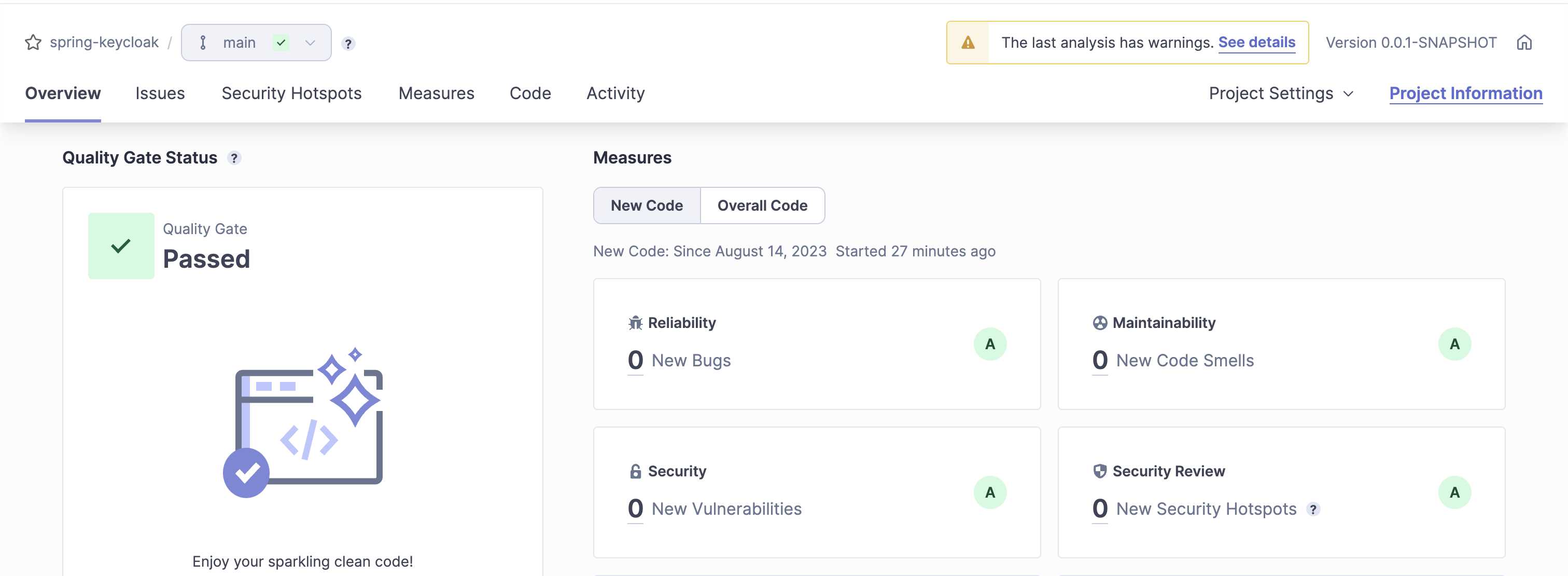
After these changes, we can run the application through our SonarQube scanner and see there are no more issues and the quality of our code has improved substantially.
There are certainly many things that could be improved in this implementation. I’m not an expert at refactoring code, and there’s no point over-engineering this project, but it’s definitely a good improvement and a good starting point to keep improving.